
In the absence of microblogging, I need a place to share all that stuff I would otherwise post to Bluesky, so I'm doing a little split now described on the following page:
There are two exciting ways to follow this blog:
Good old RSS. For stuff that rises to the level of a full post. Newsletters are also posts and come through here.
The newsletter, Fox Noises. I collect notes, notions, and links in a draft and start polishing it into something nice for your inbox once it approaches 1000 words.
This is the newsletter. Without further preamble...
New Posts
Scooping up all the scattered notions I've had on social media over the last several years into two coherent articles.
A timeline, of sorts – connecting what's happening today to the past.
AI is becoming normal technology, for better or worse – an optimistic case for the newest new technology.
The Regroup
I'm revisiting some stuff I only skimmed or experienced as passing headlines before The Strategic Retreat gave me a lot more time to read and think.
Two posts from writer John Scalzi have been on my mind in light of people I thought were friends (of the internet variety) vanishing on me because I don't think linear algebra-based thinking simulators–LLMs, or "AI"–are inherently evil because evil people are involved in the creation of a few popular variants. It's an untenable position to hold if you're sincere because it would indict all users of all technology. I prefer to believe they just haven't given it much thought past the current moment and will come to regret it later.
I Can’t Promise I Will Never Be Problematic
Please Don’t Idolize Me (or Anyone, Really)
Being a public person necessarily means some compression into a persona, but it creates an infinite space of potential disappointment and disagreement. What you do with that disappointment and disagreement is up to you. I don't have many hard lines, and I tend to think people who put their own much further ahead risk isolating themselves in ideological bubbles.
I weigh the risk of isolation higher than the risk of being more patient, and it's not hypothetical for me. I've been the person who moved on from someone over every petty little disagreement, and I did find myself surrounded by people I only realized too late I couldn't stand. Twitter-like social media made it so much worse.
The Future Of Media Is Pre-Deplatformed:
Part of the problem here is that the pillars of culture that defined coolness, that were also ransacked by it every five-to-10 years and would begrudgingly canonize it, are pretty much gone now. You could write a big feature like TIME Magazine’s “Generation X Reconsidered” cover story about Gen Z now, but no one would care. Hollywood lost to YouTube. Magazines lost to TikTok. Radio lost to Spotify. And most artist management teams are basically just hype houses now. As The New York Times’ Jon Caramanica said recently (on a livestream, it should be noted), "The gap between 'I'm a comedian,' 'I'm a content creator,' 'I'm a musician' — we used to think of those as three different jobs. They're not three different jobs anymore. It's basically just one job, which is getting attention. That's the main job.”
I call it the atomization of culture, and will as I write more here, but I know I'm not the first or only person to notice. The failure of Bluesky to grow past its natural attrition rate is credited to various things in the tech press and on the platform, but to my perspective it's the lack of a mainstream constantly producing capturable growth events. Twitter used to have a page in its ad center showing how much traffic different events got. A few hundred million impressions here, a billion there. Event after event, no month left without a spike, for a platform to A/B test retention strategies.
I would be surprised if any social network captures that much public discussion in 2026. The events still happen, but much of the discussion happens in group chats now. Anyone trying to "tweet" about it on "X" would find themselves besieged by the remaining clusters: people with skull calipers, people with an encyclopedic knowledge of consent laws, some dude with "Pray To Tibo For Resets" in his display name who is probably well-informed but a little weird. What's left of the old standards, your #AmWriting types with a hashtag and a community, are fragmentary and long-succumbed to the madness.
I've been doing a lot of thinking around identity. I covered it in pretty broad terms in Pride:
Like queer, each word for each aspect of identity comes with explanations, assumptions, beliefs, community. And conflict. I am simply too old and too gay for that noise. They go into the same basket with musician, artist, writer, photographer, and so on.
But I'm also pretty defensive of bi because of the long-standing attempt to crush it down into binary terms.
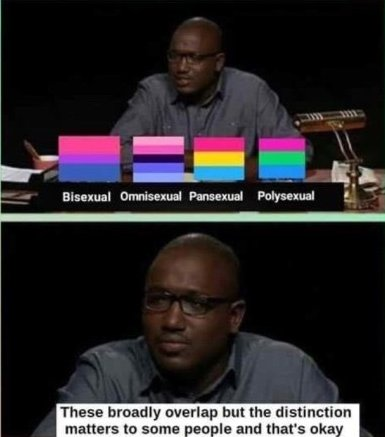
This well-circulated quote from the 1994 issue of Anything That Moves shows the attacks on the identity aren't recent, despite attempts to implicate overzealous pan Tumblr kids:
"We are tired of being analyzed, defined and represented by people other than ourselves, or worse yet, not considered at all. We are frustrated by the imposed isolation and invisibility that comes from being told or expected to choose either a homosexual or heterosexual identity.
Monosexuality is a heterosexist dictate used to oppress homosexuals and to negate the validity of bisexuality.
Bisexuality is a whole, fluid identity. Do not assume that bisexuality is binary or duogamous in nature: that we have "two" sides or that we must be involved simultaneously with both genders to be fulfilled human beings. In fact, don't assume that there are only two genders. Do not mistake our fluidity for confusion, irresponsibility, or an inability to commit. Do not equate promiscuity, infidelity, or unsafe sexual behavior with bisexuality. Those are human traits that cross all sexual orientations. Nothing should be assumed about anyone's sexuality, including your own."
Anything That Moves, issue 7, Spring 1994, p. 2
Let's pull out the key line: In fact, don't assume that there are only two genders.
For me it's as simple as: I grew up with the bi flag and bi identity and every definition I've heard for the others fits comfortably under bi, so I go with what I know. It comfortably covers the space some people use "queer" for. All the bi kids I knew didn't understand gender, much less society's hangups around it. The idea that they would turn someone down because they weren't some model cisgender binary man or woman would have seen you laughed out of town.
I'm sure there are exclusionary bi people in the same way there are people who spread the idea that bi is definitionally exclusionary, but it would be weird to hold that against entire identities.
Vibe Checks
Dollar General will be the last thing you see before you die
Sumerians Look On In Confusion As God Creates World
Jurisprudence Fetishist Gets Off On Technicality
I'm sure I'm not the only one who misses coming home from class in college to see Democracy Player (now Miro [and long-dead]) had downloaded some new stuff from TWiT and Rev3 and others over a shaky cable connection while away. TWiT, at least, is still there publishing a proper RSS feed with video enclosures for its shows. Previously.
The stuff is still out there, scattered, but the bulk seems to be filed into newsletters and YouTube channels with incentives at a platform and format level driving things.
It's the same situation with blogs. They're there, but it's nothing like it was. The silos have won. For now?
Archive Dive
A collection of pages from the EDN semiconductor annual for 1968, just as the integrated circuit boom was starting to settle around a few ideas like TTL and MOS. A rare snapshot courtesy of bitsavers. See the caption.







From EDN_V13_N12_19680624_Semiconductor_Annual.pdf @ bitsavers