
A new newsletter for the official start of Spooky Season. The leaves are turning, there's spiders in the air, and the clock has started for discount candy.
1: biography of saints or venerated persons
2: idealizing or idolizing biography; an account that smacks of hagiography
Social media, especially Twitter-shaped social media, seems to fill the same space as TV news and newspapers. You're receiving an information-shaped product, not information. At best, it's a curated stream of experiences. The few unguarded shares tend to be people in crisis letting the mask fall a little before scrubbing and going back to the crafted image.
It's also...fleeting. 4500+ people follow my Bluesky account. If I make the right posts about the right topics, lots of people interact. And then nothing. No real impact. This has been true, for me, of social media since early on. If you're not there, you don't exist. I asked Bluesky's own little AI tool to check to see if anyone noticed I was gone in a tangible way:
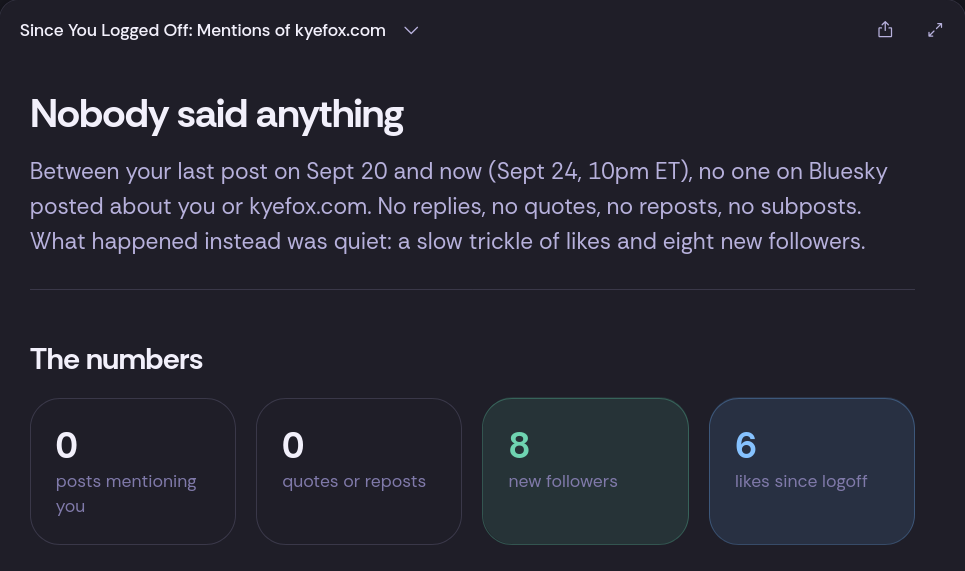
Social media is like the domed city in the 1976 classic Logan's Run. It dangles the promise of Renewal in front of you while keeping you trapped in a hell created by people who can't stop reliving their 20s. All it's missing is an exit guarded by a homicidal robot.
There will be no dramatic scene where the city falls in the background while 4500 people follow you into the world outside the dome. You have to find others who escaped and rebuild it piece by piece.
Shapes and Voids
Fritz Zwicky coined the term dark matter, but he had a more practical invention:
He is remembered as both a genius and a curmudgeon. One of his favorite insults was to refer to people whom he did not like as "spherical bastards", because, as he explained, they were bastards no matter which way one looked at them.
It Came From The Blogosphere
There's a stock dismissal when people say they're quitting social media: "this isn't an airport, there's no need to announce your departure."
Which is bullshit.
The power and value of being able to write without arbitrary restriction or futile hedging to protect yourself from the instant, thoughtless reactions of strangers is that we can develop and share our unique perspectives on things. Our perspectives on why we move toward or away from certain things are not special cases where that value is nullified by some unseen force.
And I can say that here without some dipshit racing to reply to score points with their cluster.
Once I was in a place with a more reliable connection, I reconnected, but not to social sites. I tracked the news enough, but not obsessively. I kept in touch with friends, mostly via text and WhatsApp. But when it came to social, I'd venture in and turn back around, Grandpa Simpsons style.
Because logging in after a while away, it was painfully clear just how broken it all was. All the things that made social media so vital a decade or two ago have fallen apart, replaced by algorithms, engagement hacks, and endless, bottomless, screaming.
We're in a cycle of constant outrage (which is not to downplay how actually outrageous the time we're living in is), pushed by the insatiable need for engagement that has been stoked by algorithms and the misaligned incentive structures that have emerged in the last few years that need people to stay mad bro to keep the dollars flowing.
There’s one lesson the Tetris effect teaches us: whatever you focus on long enough will end up shaping your thoughts. This can be a good thing since it’s how we learn new skills and discover new ideas. Sadly, less and less of our attention is focused intentionally. Instead of picking what we want to see we let other people decide what is supposed to be good for us.
I've been putting more attention in moderated spaces. One of them is a Discord where invites open up the same way a mysterious vanishing city appears, so you get the antidote to the Eternal September effect where new people come in waves and have time to learn the local norms before the next wave. The other is Metafilter, where you need an account to post. It's a little more rowdy, but I don't really like Discord and would drop it if forced to choose by time and attention constraints.
Basically: spaces where you don't necessarily know everyone, but where being more patient and charitable isn't a hazard for time or wellbeing the way it is on social media. Where a homicidal robot keeps people in the city in Logan's Run, frozen in time, moderators and community norms keep the homicidal robots out in real communities.
One of my songs made its way into the Metafilter podcast back in 2020.
The Internet Wasn't Supposed to Feel Like This:
Being a mid-to-late millennial has put me in an interesting spot. I remember the world before the internet, but I also grew up alongside it as it became what it is today. I was a kid in the ’90s with endless time to explore online compared to the generations before me. If the internet broke, I had to figure out how to fix it, same with the family computer. That curiosity shaped who I am today. It makes me sad that the next generation will never know the internet I grew up with. The weird, wonderful, human one. The internet used to feel like a place; it was messy, diverse, and human. Now it is a product. It’s optimized, sanitized, and owned. The shift from small communities and personal sites to algorithm-driven feeds hasn’t just changed how we communicate; it’s reshaped how we think and feel. There was a time when the internet felt like wandering through someone’s home. Now it feels like a giant mall.
Rebuilding The Web We Lost (2012):
But the most important question we can ask is: How do we rebuild the positive aspects of the web we lost? There are a few starting points, building on conversations we’ve been having for years. Let’s look at the responsibilities we must accept if we’re going to return the web to the values that a generation of creators cared about.
There was an attempt. I'm not convinced ATProto has failed, but I do think it's taking too long and remains too dependent on Bluesky with all the usual problems with Twitter-like social media. Mastodon/ActivityPub has failed abysmally or succeeded spectacularly depending on the individual: the former if you wanted to see it take on centralized social media, the latter if you think a handful of isolated clusters of communities is the ideal. Either way, having under a million active accounts left concentrated on a few servers on Mastodon and Pixelfed instances after all this time isn't a great sign.
Many possibilities open when you see the codex as a technology rather than as an object of reverence. Chop up your books:
At the risk of parroting ‘you can just do things’, I’m telling you: You Can Just chop up your book. Nobody will call the cops. Authors don’t mind!
The neat thing about owning something is you can do what you want with it. I don't share the author's view on chopping up mass market books no one wanted for fair use training of useful machine learning models or to provide previews. But that's the kind of civil disagreement possible in a medium that doesn't reward snap judgements and snappy replies.
Have you ever thought: "did the good parts of peak Cracked re-emerge anywhere else?"
Seanbaby: Dirty Tennis is a VHS guide to cheating at tennis written by Dick Van Patten’s son. It’s not exactly a spoof of anything and takes place in a universe without consequence or reason featuring Knots Landing’s Nicolette Sheridan. To think this is in any way describable is madness, though. These are the final imaginings of a tennis player’s brain as a wild animal bites through their skull. Nightmarish, unfinished ideas of senseless tennis, but hornier than I’m making it sound. I guess picture a tennis enthusiast’s head getting chewed off by a really hot bear.
Brockway: I’ve seen that bear. That bear can get it. And that bear takes it.
But to the point: The fact that one ‘mock instructional fitness video disguising a mean-spirited comedy vanity project’ to exist is lunacy. For pitching it, you should be laughed out of the room. For writing it, you should be lashed to a donkey and sent into the desert. For actually producing and distributing it to the market, you should be killed. No jokes. Just put down humanely with a boltgun because something is wrong in your brain that can’t be made right. But for two of these videos to exist? This is treason against reality.
It's paragraph after paragraph of ruthless roasting from there. Of course, 1-900-Hotdog has many writers and covers more than just questionable direct-to-video sludge, so don't let this one stop you if "paragraph after paragraph of ruthless roasting" isn't your jam.
A tiny bit of politics, and optimism
The DSA is getting some good people elected, but the conservative project to destroy liberal institutions has had decades to work mostly ignored by the DNC, and it made a lot of progress under Trump (55% by the project 2025 tracker).
On the flip side, the rapid advance from Trump's sliming down the escalator in 2015 to today is evidence things can move fast if you have the right people, policy, and vibes. We just have to fill out that trifecta well.
It's easy to live in the way things are so long you forget they weren't always that way, and that things can change. Ten years ago almost no one believed Trump could get elected. Why should we take seriously people who believe quick, positive change is impossible when recent history proved otherwise?
On that note, CrashCourse did a video on the history of political polarization in the US and the second entry in the new series on how the system makes this worse. The takeaway: none of this is inevitable or permanent.
Archive Dive
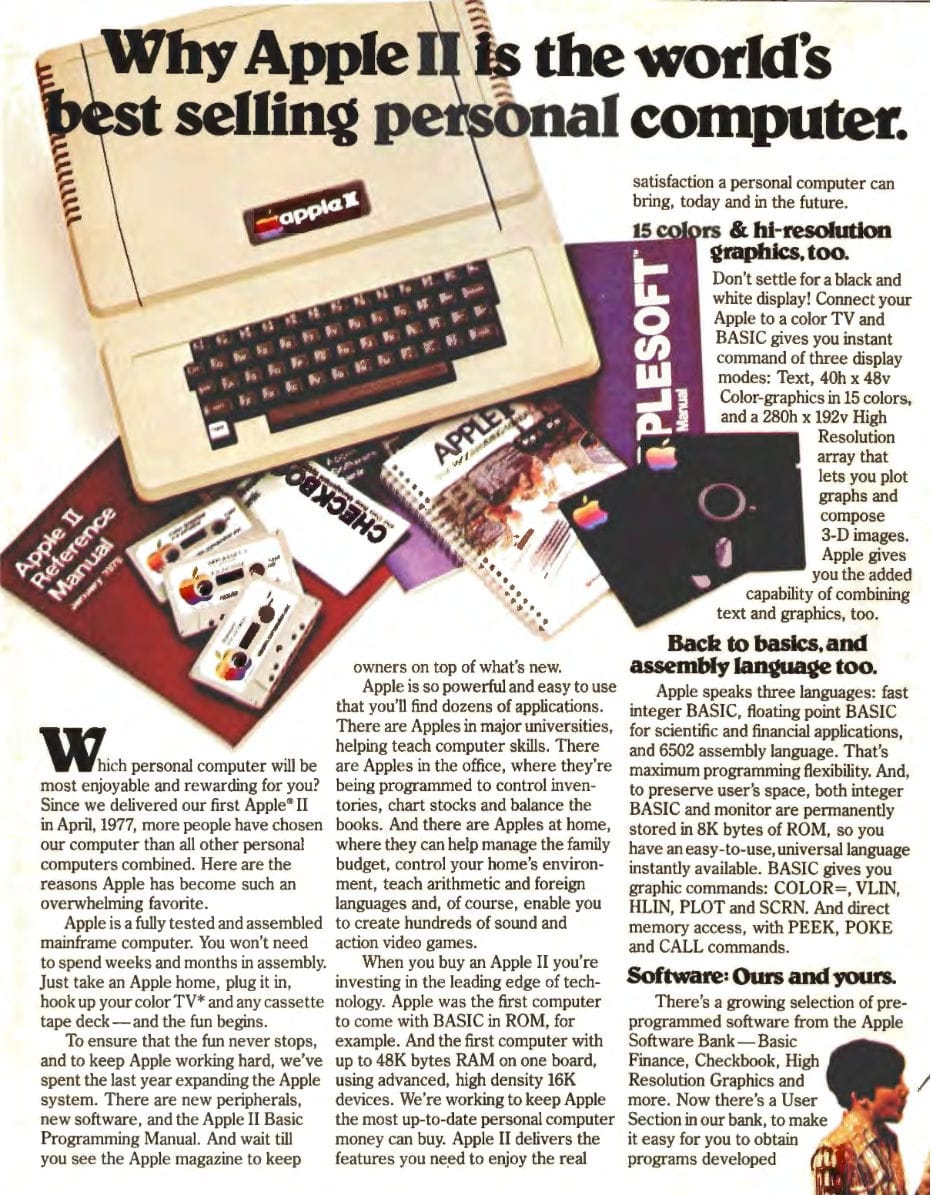
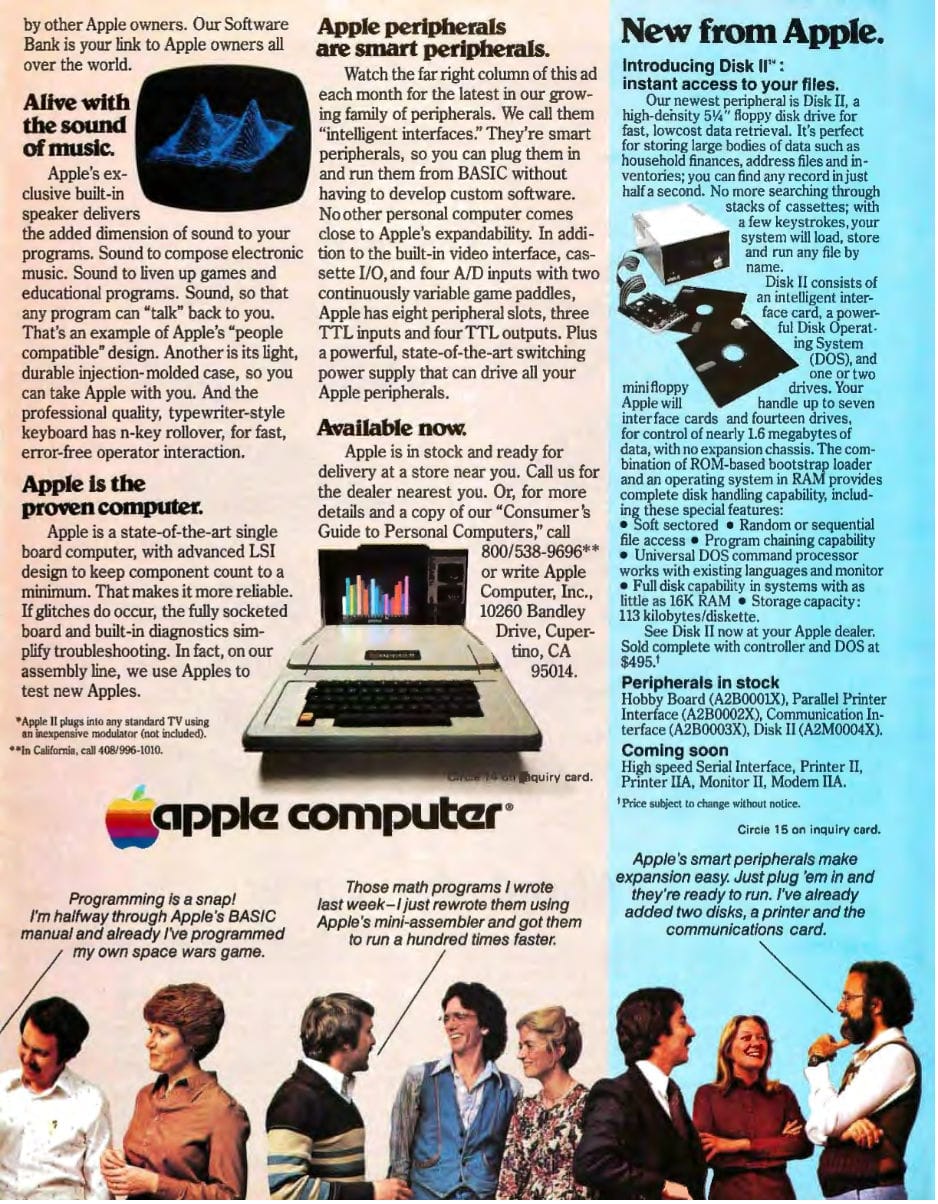
197807 Byte Magazine Vol 03-07 Antique Mechanical Computers.pdf197807 Byte Magazine Vol 03-07 Antique Mechanical Computers.pdf from Vintage Apple's Byte Magazine archive

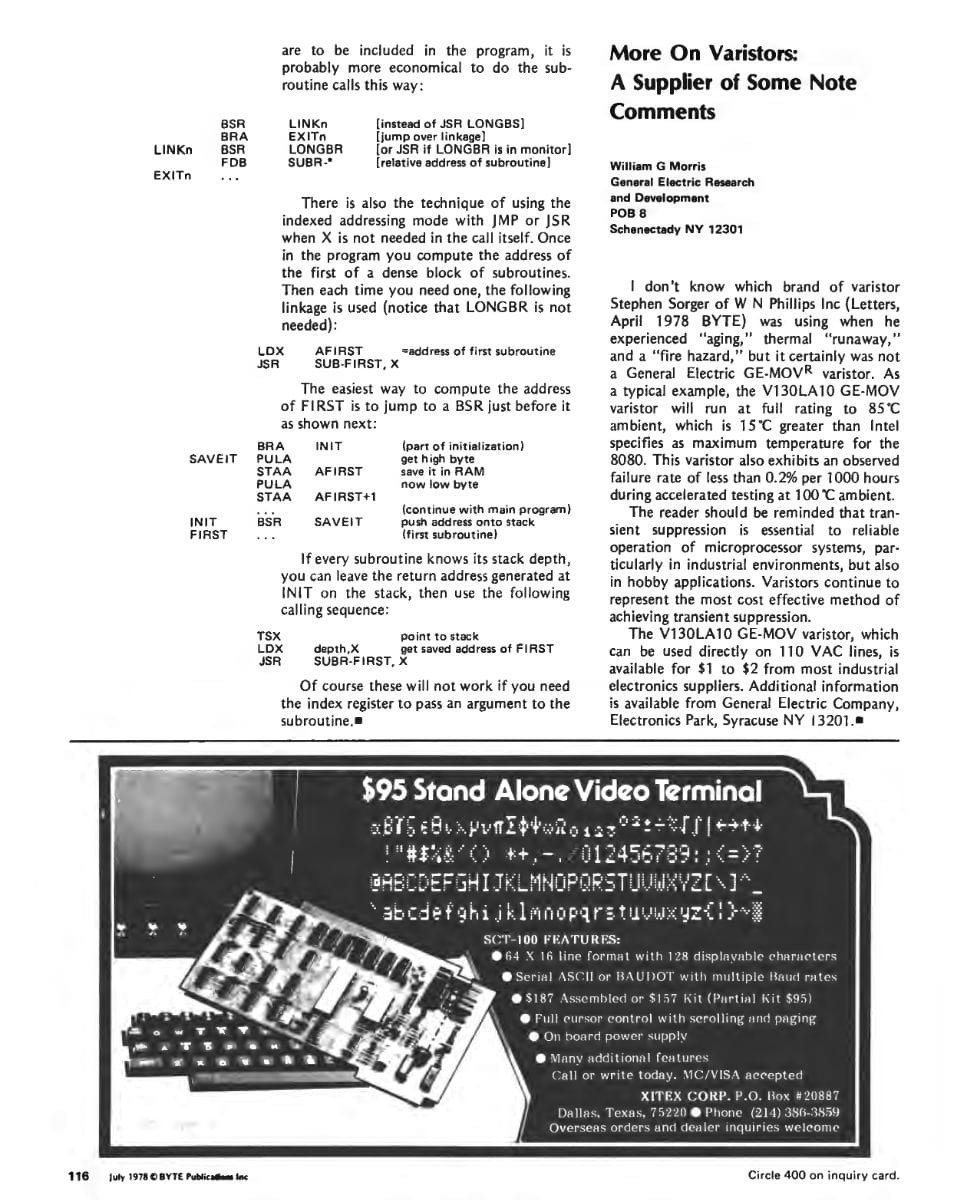
197807 Byte Magazine Vol 03-07 Antique Mechanical Computers.pdf197807 Byte Magazine Vol 03-07 Antique Mechanical Computers.pdf from Vintage Apple's Byte Magazine archive